
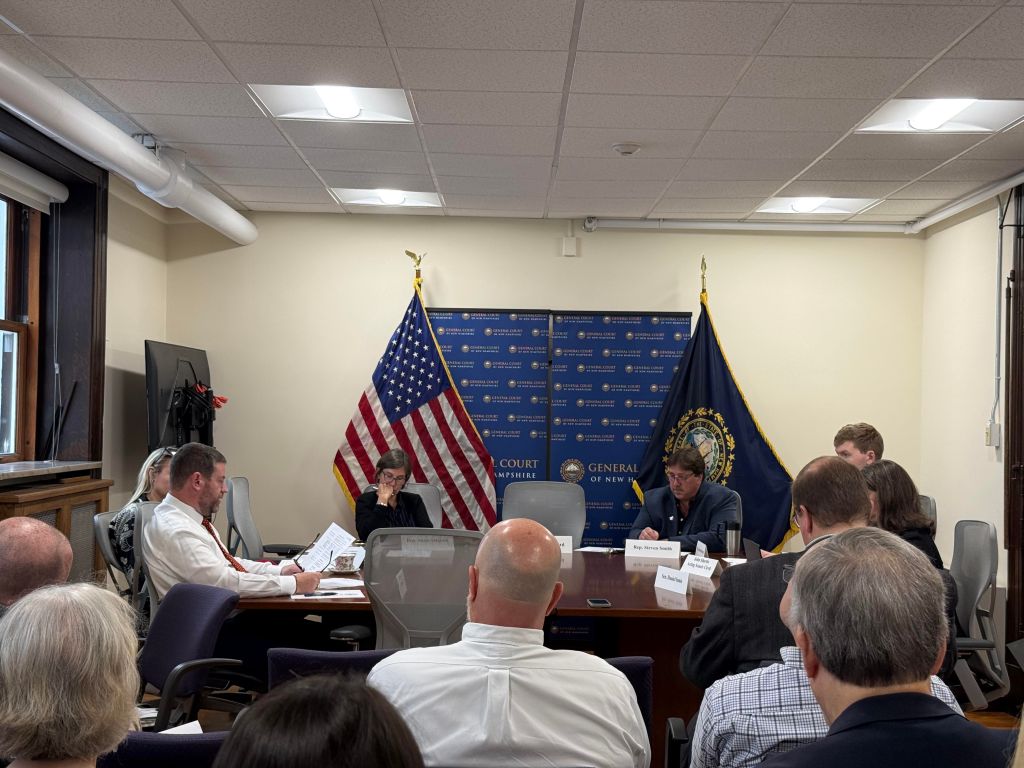
Each year, Representatives can file bills. This is an election year, so some will be doing this for the first time. Today, several of us met with OLS (Office of Legislative Services) to see what we can do to make this work better for everyone. Suggestions included having several “continuing education” events, adjusting deadlines, improving user interfaces, and enhancing communication.
For a New Hampshire legislator, the bill filing process begins months before the legislative session convenes. The first formal step is submitting a Legislative Service Request (LSR) to the Office of Legislative Services (OLS). An LSR is simply a request asking OLS attorneys and bill drafters to prepare legislation based on the sponsor’s idea. Each request receives an LSR number and is publicly listed with a brief title and sponsor information.
The process generally works like this:
- Develop the proposal
- The legislator identifies a policy issue.
- They often consult constituents, agencies, advocacy groups, or other legislators.
- They determine whether the proposal requires a statutory change, constitutional amendment, or another legislative vehicle.
- File an LSR
- The legislator submits a drafting request to OLS during the filing period established by House or Senate rules.
- The request should include enough detail for drafters to understand the intent.
- OLS assigns an LSR number and publishes the request with a descriptive title.
- Drafting by OLS
- Legislative attorneys research existing law.
- They prepare bill language in proper statutory format.
- The drafter may contact the sponsor to clarify intent or discuss technical issues.
- Several drafts may be exchanged before the sponsor is satisfied.
- Sponsor approval
- The prime sponsor reviews the completed draft.
- Any co-sponsors are added.
- The sponsor signs off on the draft, authorizing introduction.
- Bill introduction
- The finalized LSR becomes a House Bill (HB), Senate Bill (SB), House Constitutional Amendment Concurrent Resolution (CACR), or another legislative vehicle.
- It receives a bill number.
- The bill is formally introduced at the start of the legislative session.
- Committee referral
- The Speaker (House) or Senate President refers the bill to the committee with jurisdiction over its subject matter.
- The committee schedules a public hearing.
- Legislative process
- Public hearing.
- Executive session (committee deliberation and vote).
- Committee recommendation.
- Floor action by the originating chamber.
- If passed, the bill repeats the committee and floor process in the opposite chamber.
- If both chambers agree on identical language, the bill is enrolled and sent to the Governor for signature or veto.
Important practical considerations
- Deadlines matter. The House and Senate establish filing deadlines every biennium. Missing an LSR deadline generally means waiting until the next legislative cycle unless special procedures are used.
- OLS is nonpartisan. Legislative Services does not advocate for or against legislation; its role is to accurately draft the sponsor’s proposal.
- Second-year restrictions. During the second year of a biennium, House rules prohibit introducing legislation substantially similar to certain bills that were already defeated or otherwise disposed of in the first year, with limited exceptions.
Typical timeline
| Time | Action |
|---|---|
| Early fall | Legislator develops idea and files LSR |
| Fall | OLS drafts legislation and works with sponsor |
| Late fall / early winter | Sponsor approves final draft |
| January | Bill is introduced and assigned an HB or SB number |
| January–March | Committee hearings and executive sessions |
| Spring | Floor votes, crossover to the other chamber |
| Late spring / early summer | Final passage and Governor’s action |
This LSR-based drafting process is one of the distinguishing features of the New Hampshire General Court, allowing legislators to work closely with professional, nonpartisan drafters before legislation is formally introduced.
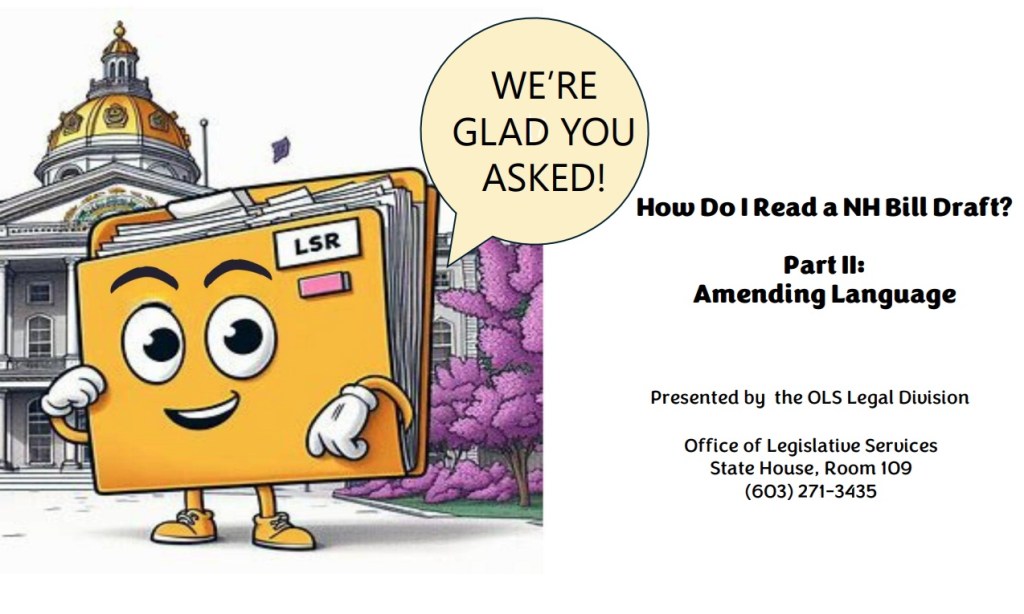
For a quick intro to understanding amending language, see https://gc.nh.gov/memberportal/help/How%20to%20Read%20a%20NH%20Bill%20Draft%20-%20Part%20II.pdf





Leave a Reply